

NGC 6888 (Crescent Nebula)
di Giovanni Sebellin inserita il 5 Novembre 2024

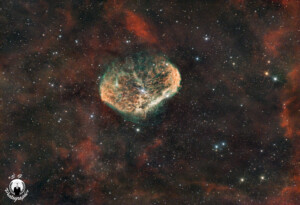
The Crescent Nebula (also known as NGC 6888, Caldwell 27, Sharpless 105) is an emission nebula in the constellation Cygnus, about 5000 light-years away from Earth. It was discovered by William Herschel in 1792. It is formed by the fast stellar wind from the Wolf-Rayet star WR 136 (HD 192163) colliding with and energizing the slower moving wind ejected by the star when it became a red giant around 250,000 to 400,000 years ago. The result of the collision is a shell and two shock waves, one moving outward and one moving inward. The inward moving shock wave heats the stellar wind to X-ray-emitting temperatures.
The Crescent Nebula is a rather small object located about 2 degrees Southwest of Sadr. While considered bright by astronomical imaging standards, visually it is relatively faint. For most telescopes it requires a UHC or OIII filter to see. Under favorable circumstances a telescope as small as 8 cm (with filter) can see its nebulosity. Larger telescopes (20 cm or more) reveal the crescent or a Euro sign shape which makes some to call it the "Euro sign nebula".
Newton 200/1000
ASI 294 mc-s pro, gain 122, temp. -10
Zwo Eaf
Guide 60/240 with ASI 120 mc-s
ASI air plus
Coma corrector baader Mark iii
Optolong l-ultimate (20h*600") + l-quef (4h*300")
Eq6 pro kit rowan
Dark, flat, dark flat
#CoelumAstronomia #Astronomia #Astrofotografia #Universo #Astronomy #Astrophotografy #Universe #Cosmologia #Cosmology
#CoelumAstronomia #Astronomia #Astrofotografia #Universo #Astronomy #Astrophotografy #Universe #Cosmologia #Cosmology